What Is Indoor Air Quality Testing?
Indoor air quality (IAQ) testing identifies the types and concentrations of airborne contaminants present inside a home or building. Unlike mold testing, which focuses on biological growth, IAQ testing covers a broader range of chemical and particulate pollutants that accumulate in indoor environments — many of which are invisible and odorless.
Modern homes are built to be airtight for energy efficiency. While this reduces heating and cooling costs, it also traps pollutants that would otherwise disperse. Volatile organic compounds (VOCs) off-gas from building materials, furniture, and household products. Carbon monoxide builds up from combustion appliances. Formaldehyde accumulates from pressed wood and composite materials. Without adequate ventilation or monitoring, these contaminants build to levels that affect health.
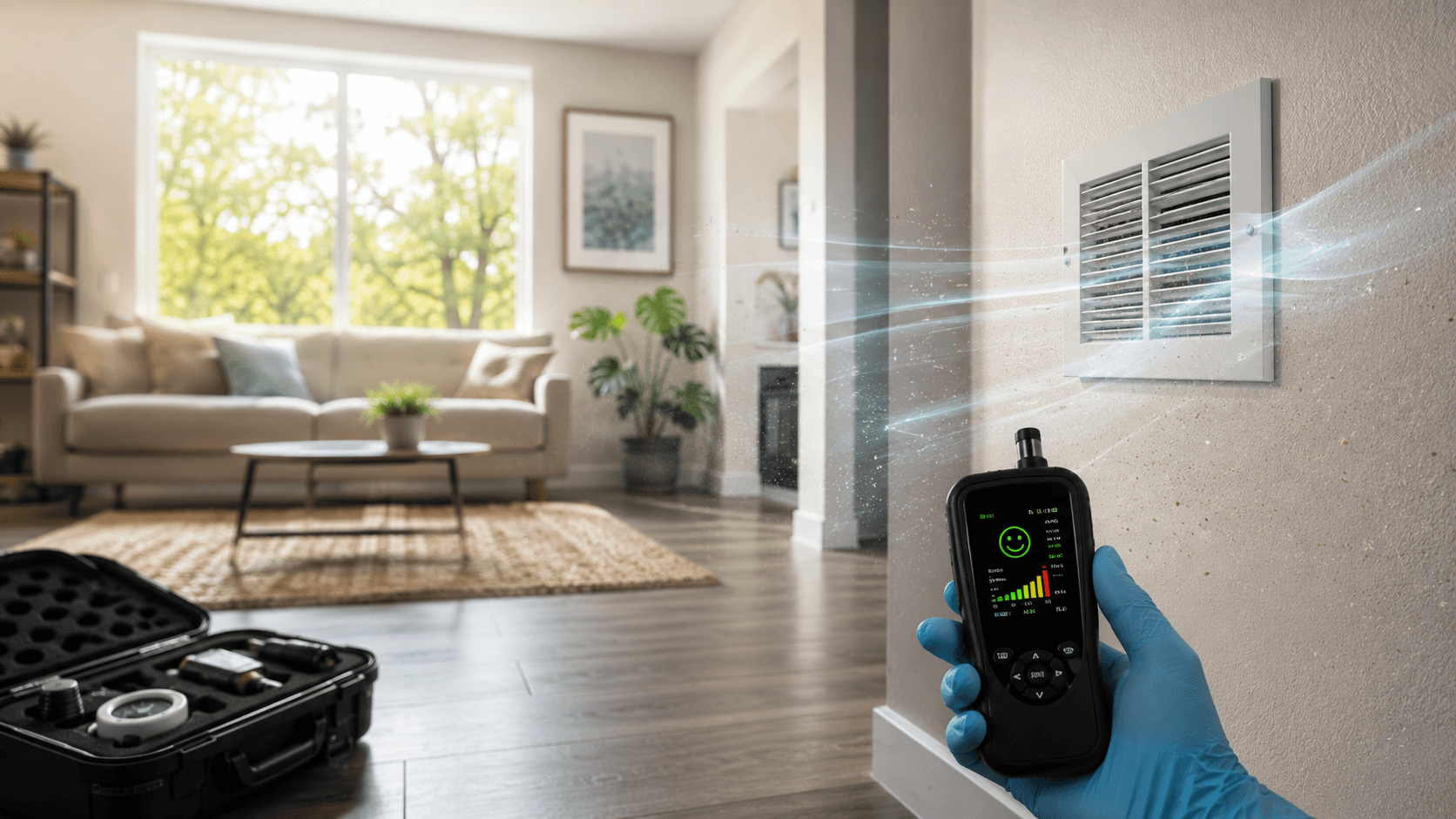
Hawk Home Inspection uses calibrated professional monitoring equipment to evaluate your indoor environment. Results are presented in a clear report with your actual readings compared to EPA and health authority thresholds, along with practical guidance for improving air quality when needed.
- Persistent headaches, fatigue, or eye irritation indoors
- Worsening allergy or asthma symptoms inside the home
- Recent renovation, new flooring, or new furniture (VOC off-gassing)
- Gas appliances, furnace, or fireplace without fresh-air venting
- Tight, well-sealed, energy-efficient home with limited air exchange
- Attached garage or basement mechanical room
- Strong or unusual chemical odors inside the home
- HVAC system has not been serviced or cleaned recently
Air Quality Testing FAQ
What is the difference between air quality testing and mold testing?
Mold testing specifically identifies the presence, type, and concentration of mold spores in the air or on surfaces. Indoor air quality testing covers a broader range of chemical and particulate pollutants — VOCs, carbon monoxide, formaldehyde, particulate matter, and nitrogen dioxide. Both address different aspects of indoor environmental health, and mold can be included as part of a comprehensive air quality evaluation.
Can indoor air really be worse than outdoor air?
Yes. The EPA estimates that indoor air is typically 2–5 times more polluted than outdoor air, and in some cases up to 100 times more polluted. Modern homes are built to be airtight for energy efficiency, which reduces natural ventilation and concentrates pollutants from building materials, furnishings, appliances, and occupant activities.
How do I know if my indoor air quality is a problem?
Common signs include headaches that improve when you leave the home, persistent fatigue, eye or throat irritation, worsening asthma or allergy symptoms indoors, and unusual odors. However, many serious indoor air pollutants — including carbon monoxide, radon, formaldehyde, and many VOCs — have no smell or taste. Testing is the only reliable way to know.
Is carbon monoxide testing the same as a CO detector?
Not exactly. Standard CO detectors alarm only at immediately dangerous levels (typically 70 ppm or above). Professional CO monitoring measures actual concentration levels, identifies the source, and detects the low chronic exposure levels (9–35 ppm) that cause long-term health effects but won't trigger a standard detector.
Do you offer air quality testing in all Northwest Indiana communities?
Yes. We serve Dyer, Valparaiso, Crown Point, Hammond, Gary, Merrillville, Munster, Highland, Schererville, and all surrounding Northwest Indiana communities.
Serving All of Northwest Indiana
We serve communities across Lake County, Porter County, and LaPorte County. Click your city for local inspection information.
Don't see your city? Call us — we cover a wide area.
Breathe Easier — Know What's in Your Air
Most indoor air pollutants are invisible and odorless. Professional testing gives you the facts and the path forward. Free estimates available.